Future Leadership Competence: Leading Employees Through Change and Times of Anxiety

Summary: Future anxieties and fear of change have become our new pandemic. Employees blocked by fear are ineffective and infect others. This article shows why reassurance and motivation are counterproductive – and which strategies help leaders promote self-determination and agency within their teams.
1 | Why Fear of Change Has Become a Leadership Task
Fear of change and negative expectations about the future are no longer just private matters – they have reached the corporate world and become a leadership responsibility. Future anxieties and fear of change have become our new pandemic. Employees blocked or paralyzed by fear call in sick more frequently, complete tasks much less effectively, and spread worry to other colleagues. In change processes too, many leaders experience a similar effect: employees appear unsettled, blocked, or downright paralyzed. The first impulse is often to reassure or motivate them. Yet this often makes the situation worse.

2 | Why Motivation and Reassurance Don't Work for Anxiety
Reassurance
"It will be fine", "It seems bigger than it really is right now", "We're all in the same boat", "In a few weeks you'll probably laugh about this."
These and similar statements convey: "Your fear is exaggerated." Employees don't feel taken seriously. Because they feel this fear – it's real! The fear is relativized without acknowledging its emotional force. The message is meant to reassure but is often experienced as defensive or as "not wanting to understand."
Motivation or Praising Personal Performance
"I trust in your competence and sense of responsibility, so I'm sure we'll find a good path together."
This increases pressure and can even deepen the paralysis. People who are afraid are blocked in their actions. Even if they want to, they cannot deliver the performance that is expected of them. Employees thus enter a spiral of performance pressure and fear of failure. In the worst case, prolonged overload can lead to burnout, anxiety disorders, or depression.
If you notice signs, encourage your employees to seek professional support. Signal that it is a sign of strength to seek help before longer-term psychological disorders develop.
3 | How Employees Slide into Helplessness and Become Blocked
When a leader "means well" but uses the wrong interventions, employees can unconsciously be pushed into a childlike, dependent position, while the leader slips into the caring parent role and feels exhausted and frustrated. The result: helplessness instead of self-determination on both sides.

Fear of the future is not simply a feeling, but closely linked to our intellect and imagination. We envision what could happen – and the more we think about it, the bigger the threat appears. Relaxation techniques only help superficially because they don't change the thinking. And thinking is very powerful.
When leaders address these patterns like "I'm at the mercy" or "I have no control anymore" with reassurance or motivation, employees slip back into a memory of when they were actually small and helpless. This is experienced as real and present and activates unconsciously. Through reassurance, leaders reinforce feelings of helplessness and dependency – instead of resolving them.
4 | The Psychological Lens: Why Fear Is So Powerful
Understanding Psychological Possibilities
Our fears are often old acquaintances. According to Jeffrey Young's Schema Theory, they are rooted in schemas – internal patterns that arise from earlier experiences.
Those who experienced uncertainty as dangerous in childhood also react more sensitively as adults to unclear future prospects.
Fear then activates not just current thoughts, but entire internal stories.
That's why it affects us deeply: negative news couples with our neural networks, our experiential histories. As soon as we imagine a negative future, we experience it physically and real. So we react not just to facts, but to our expectations.
That's why the sentence "You don't need to be afraid" is usually counterproductive: Because we do have it! Fear is more real than anything else in that moment.
5 | "Those Who Have Fear Have a Future"

The hypno-systemic therapist Dr. Gunther Schmidt coined this phrase. He describes how fear shows us that we think in scenarios that haven't occurred yet. It's an indication that we have the creative scope of imagination – if we use the energy of fear instead of just numbing it.
6 | How the Psyche Works - Self-Regulation Can Be Learned
Julius Kuhl's PSI Theory (Personality Systems Interactions Theory) describes how our psyche connects different systems: emotions, motivation, behavior, and intellect are one system. In fear, our brain slips into analysis mode (state orientation): we ruminate a lot, act little.
Only when we manage to switch back to self-regulation mode (action orientation) do we regain the feeling of being capable of action. The feeling of self-determination is the counterpart to fear.
Fear is therefore less a signal that wants to be calmed – but rather an indication that we need to rethink our strategies. Future anxiety screams: "Do something to become capable of action!"
Before we can feel better or react more calmly, we need to tackle fear where it originates: in the mind. And that's exactly what needs to be occupied – not with reassurance, but with strategies that lead us step by step out of paralysis.
7 | Strategies Against Future Anxiety in Employees
Take the adult position instead of the parent role!
7.1 | Name It Instead of Placating - The Demon Loses Its Power When You Give It a Name
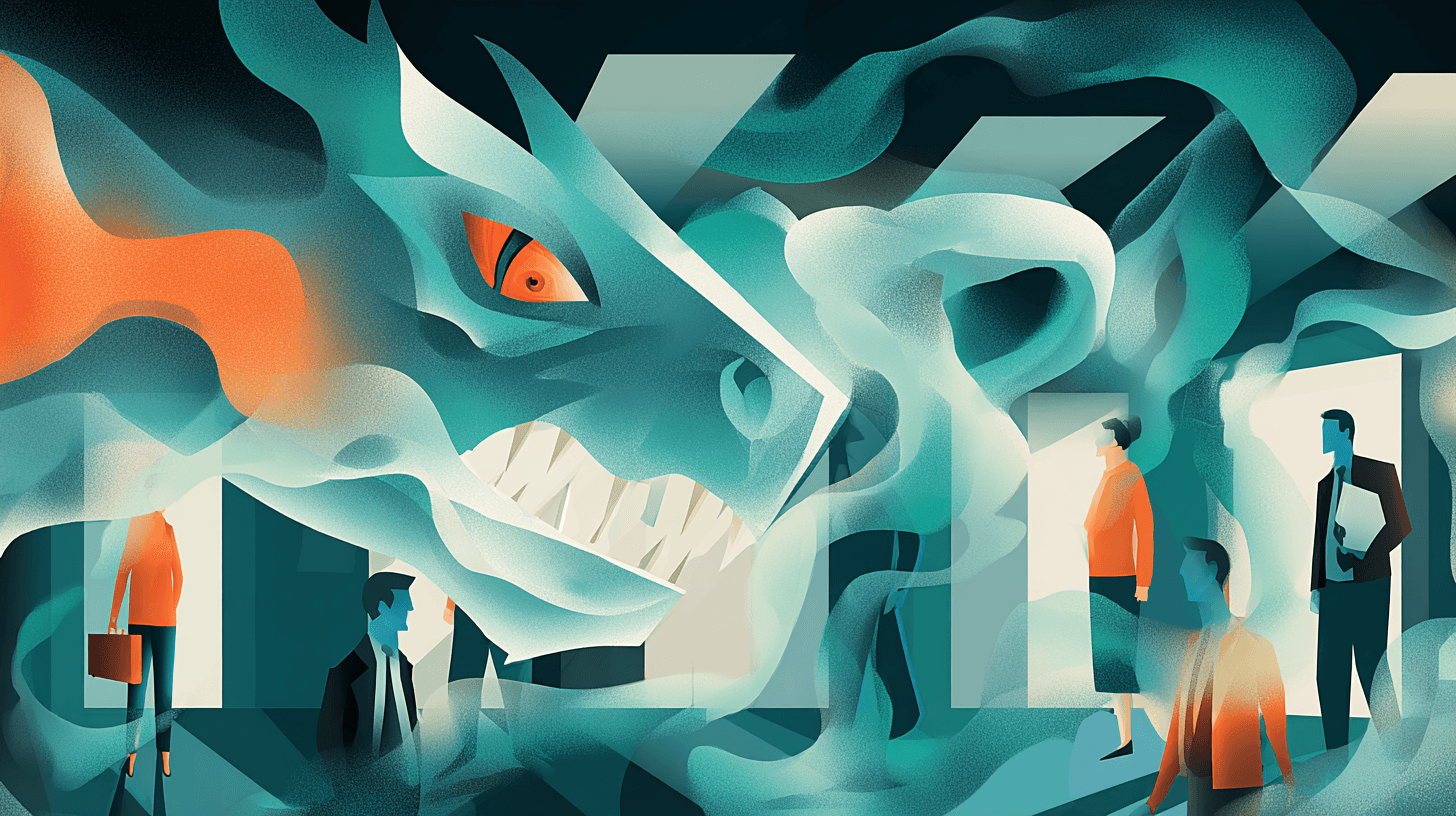
- "I see that this change triggers worries and fears."
- "It's understandable that uncertainty awakens fears."
- "Something is stuck and blocked right now. We can overcome this together."
Explain the fear mechanism as a dysfunctional form of imagination.
Develop a joint action strategy to experience self-efficacy.
7.2 | Level of Thoughts – Structure Instead of Rumination and Motivation
Fear is reinforced by thoughts: employees imagine what could happen. Leaders can help structure this flow of thoughts and use the energy bound in the intellectual system for other content.
- Work with concrete scenarios: "Which of these changes will realistically occur in the next 6 months?"
- Differentiate together: "What of this will concretely change my work / our team?"
- Use the marked points as a basis: "Which of these changes can we influence?" "What will we tackle tomorrow?"
👉 This transforms rumination into focused thinking – and the mind gets a clear task: develop strategies instead of letting fears circle.
7.3 | Level of Emotions – Use Experiences Purposefully
Future anxiety triggers strong feelings. Instead of suppressing them, you can remind employees of situations they've already mastered:
- "When have you faced a difficult change before?"
- "How did you manage to deal with it then?"
- "Which resources or support did you use?"
- "Which resources do you bring, which lie in our team, which can I personally make available to you?"
By making these parallels visible, you help employees experience emotional self-efficacy: "I've mastered uncertainty before – so I can do it again. By proceeding concretely!"
7.4 | Level of Motivation – Actively Shape the Future
Motivation alone isn't enough. The key is translating it into concrete actions:
- Ask: "What small action can you take today that moves us forward as a team?"
- Encourage requesting support – whether from colleagues, other departments, or you as a leader.
- Create weekly reflection moments: "What have you, what have we as a team, controlled and shaped ourselves? What has changed as a result?"
- Document and communicate the changes!
👉 This way motivation doesn't become a slogan ("You can do it!"), but active shaping.
7.5 | Level of Self-Regulation – Strengthen Trust
Self-regulation emerges when employees experience: "I have influence."
- Make changes and differences from the initial situation visible and affirm them!
- Promote positive feedback among each other.
- Protect the team from destructive voices that amplify fears. Remain rigorous when negative voices try to torpedo the strategy.
- Address this openly, react empathetically to setbacks by making clear that perseverance costs energy.
- Return to the strategy of concrete steps: which resources are needed to stay constructive?
- Don't let yourself be unsettled.
Doubt is the counterpart to trust. As a leader, you can actively help shift the focus: away from the idea that "when everything is good or the external situation has changed in my favor, then I don't need to be afraid," toward continuous progress in one's own creative scope.
👉 Future anxiety loses its power when employees experience that they can act self-determinedly step by step.
8 | Conclusion
Future anxiety in employees is not a sign of weakness, but an expression of change pressure, regardless of whether the trigger is future anxiety or a reaction to change processes. Leaders who react with reassurance or motivation unconsciously reinforce helplessness.
The alternative: adult position and strategies of self-determination. With professional leadership coaching, fear turns into a resource that transforms the team into capability for action – and makes change processes successful.
Leaders have a choice: reassurance and motivation as a first reaction to fears create dependency – concrete strategies at all levels create real self-determination.
By structuring thoughts, acknowledging emotions, translating plans into concrete action, and promoting self-regulation, you help your employees transform future anxiety into agency and trust.
9 | Summary of Tips for Leaders
- Avoid platitudes like "Everything will be fine."
- Hold space where fear can be expressed openly.
- Translate worries into concrete questions and action plans.
- Work together on small, realistic steps.
- Use future anxiety as a signal for creative scope.

Support for Leaders in Times of Change
Are you currently facing a change process or noticing that your employees are blocked by fears? I support you with team workshops and individual leadership coaching to transform future anxiety into self-determination – and make your team and yourself sustainably capable of action.
Book Free Initial Consultation