When Images Speak - An Introduction to Katathym Image Experience According to Hanscarl Leuner

"I can just imagine things on my own, I don't need therapy for that!"
True.
The ability to visualize something internally and to imagine is as old as humanity itself. Cave painting discoveries suggest imaginative capabilities existed even in the Stone Age.
The cave paintings bear witness to the first symbolic representations of meaning. Like these handprints that remind us of human presence and serve as signs bearing witness to their existence. A symbolic authentication of a meeting and a community.
1 | The Katathym Function of Symbols in Image Experience
How can symbols emerge in imaginations? Through the stimulation of our imagination by initial images, they arise involuntarily, bypassing our planned reasoning. This is the magic of the psyche.
Hanscarl Leuner (1919-1994) developed Katathym Imaginative Psychotherapy (KIP), a method based on depth psychology that enables affective, emotionally-colored experiencing of unconscious content in the form of images.
In a systematic process, the therapist guides the client through established starting motifs into their own elaboration of the motif. Throughout, both remain in an emphatic dialogue about what the client is experiencing.
Surprisingly, people experience themselves in imaginations not only through what they see, but also through what they hear and feel, sometimes even through scents. Symbols create the connection from the unconscious to the conscious.
In a follow-up discussion, the experience is brought back into conscious awareness and a process of insight can begin. The imaginative journey thus leads to a connection with our emotional world. It then finds its way through consciousness to a clarity that can lead the experience into a new context of meaning. From this we draw strength. In this way, we can gain deep insights into themes that we could not have accessed through imagination and reason alone.
The unconscious reveals itself through imagination and discloses solutions and strengths. The psyche can do more than just think. It is the power source of our resources.
2 | The Flower as a Motif of Current Perspective
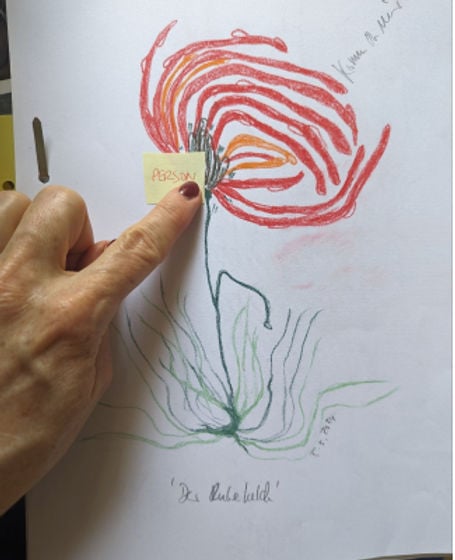
The Chalice of Tranquility
The vibrant flower reflects both dynamic temperament and the desire for centering and tranquility. The person imagines themselves sitting on the pistil inside the flower. Hence the title "The Chalice of Tranquility."
It is crucial for resource-strengthening image discussion not to proceed from one's own interpretations or even evaluations of what is seen, but to follow the client's descriptions, like a blind person experiencing another's world through descriptions. Openness, curiosity, and unconditional acceptance are prerequisites for accompanying katathym image experience.
3 | FAQ – Common Questions About KIP
Common Questions About Katathym Imaginative Psychotherapy
Answers to important questions about the KIP method

Want to Learn More About KIP?
Discover how Katathym Imaginative Psychotherapy can help you activate inner resources and gain new perspectives.
Book Free Initial Consultation