When Winter Grows Quiet: Loneliness as an Invitation to Self-Connection
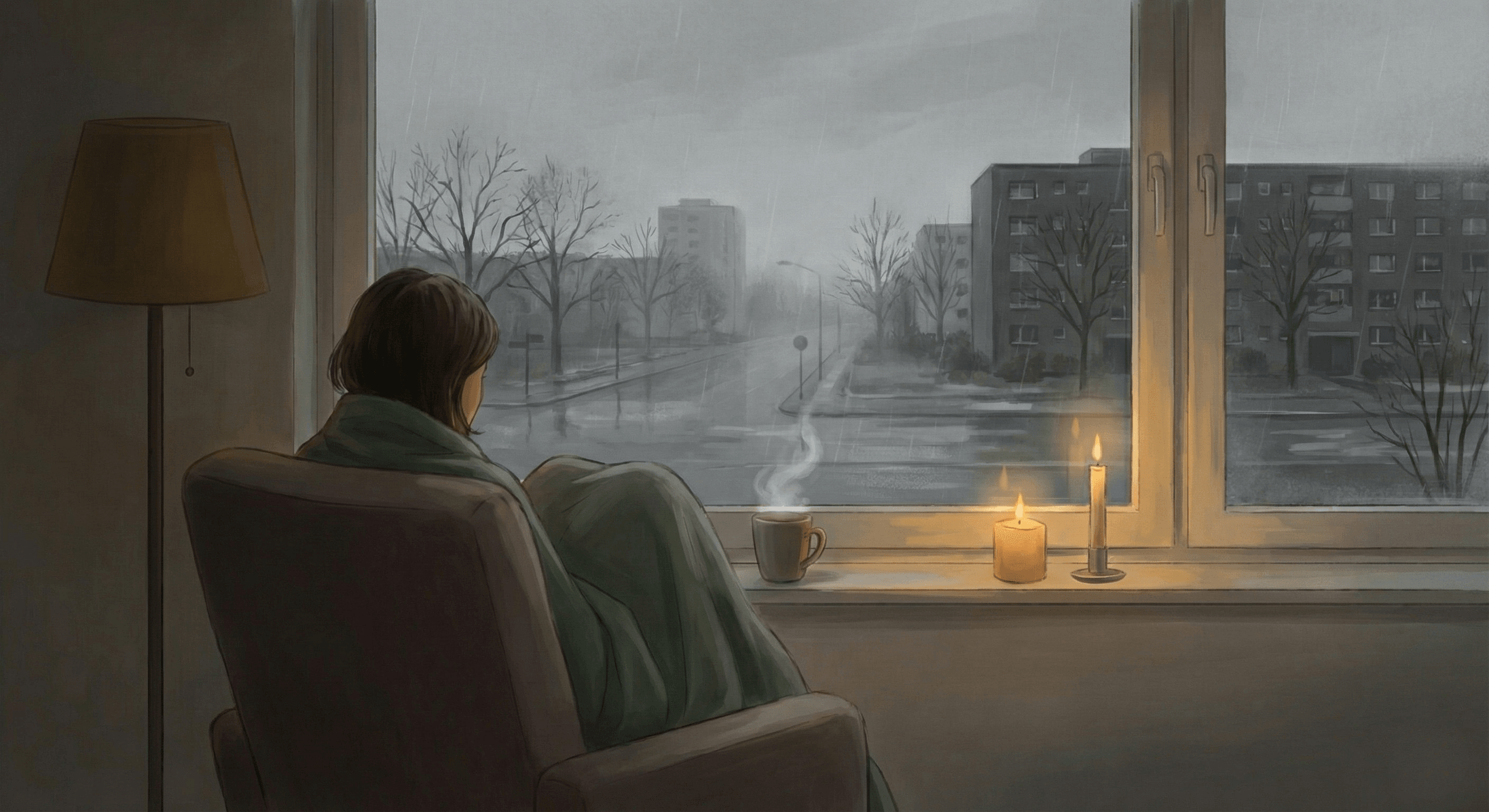
 Image was generated with AI
When Winter Grows Quiet: Loneliness as an Invitation to Self-Connection
Summary: Winter has its own unique language. When the world outside grows quieter and the days shorter, our inner life moves more strongly into focus. Many people feel loneliness, restlessness, or withdrawal tendencies during this time – sensations that are often hard to bear, yet carry an important message. From a psychological perspective, the quiet season is not only a challenge but also an invitation: an invitation to self-connection, to inner bonding, and to a loving look at what within us wants to be seen.
Many people experience the dark season as burdensome. Winter loneliness, winter blues, inner restlessness, withdrawal – all of this emerges especially when it becomes quieter and darker outside. Yet from a psychological perspective, this experience is not merely an expression of lack. It is often a signal from our inner system: an indication that something within us wants to be seen, heard, or held. We need soul food and soul time for ourselves.
In my work as a psychotherapist, I see that loneliness doesn't only speak of missing other people. It also speaks of missing connection with ourselves. Attachment theories show that we find closeness and security not only in the external world but also in our inner attitude toward ourselves.
Winter opens a special space for this. When the outside world becomes quiet, the inside becomes audible. And then the time is exactly right to care for yourself.
1 | Understanding Loneliness and Winter Blues Psychologically
Loneliness is not the same as being alone. Psychologically, we can distinguish between two forms:
- social loneliness — missing contacts, missing network, too little exchange
- emotional loneliness — the feeling of not being seen internally or having no self-contact, even when people are around us
Especially in winter, these inner states intensify because less light, less activity, and less distraction sharpen our self-perception. Feelings that were distracted by activities in summer resurface. The nervous system reacts more strongly to silence — and therein lies an opportunity: We can recognize something that escaped us in the noise of everyday life. We can understand our feelings of loneliness and learn to overcome them.
1.1 Why Silence Activates the Nervous System More Strongly
Many people expect that silence immediately calms. But biologically, the opposite often happens first.
1. In silence, external stimuli fall away – making internal stimuli louder
The autonomic nervous system (ANS) is constantly busy evaluating the environment ("am I safe or not?"). When there's a lot going on outside:
- Sounds
- Conversations
- Appointments
- Tasks
- Social interaction
…the nervous system has enough reference points to orient itself.
When it suddenly becomes quiet, the external flood of information reduces drastically. Then an irritation arises first, an inner restlessness that says:
"I don't hear anything anymore. I don't see anything anymore. Is everything okay? Am I safe?"
This heightened alertness response is evolutionarily sensible and is anchored in our reptilian brain: In the past, silence often meant danger (e.g., animals sneaking up).
Today, silence means that we perceive inner states more intensely.
Body sensations, feelings, old patterns, undigested stress, memories, loneliness, sadness, unspoken needs suddenly become perceptible.
The nervous system registers: "Something is going on inside me" – and therefore becomes more alert at first, not calmer. That's why we might want to overcome loneliness, get rid of it, sometimes feel unable to cope with the sad feelings.
1.2 Important Note: Winter Blues Is Not the Same as Depression
It's important to know that winter blues – a seasonal mood disorder caused by darkness, less light, and withdrawal – can be burdensome but is not an illness. It typically shows through:
- Less energy
- More need for withdrawal
- Mild lack of drive
- Increased pensiveness
- More need for sleep
- Sensitivity or mild melancholy
These symptoms are often situational, develop gradually, and usually improve on their own – especially when light, movement, and self-care are integrated.
However, depression is a serious illness that absolutely needs medical and psychotherapeutic support.
It can intensify in winter but is not limited to the season.
Typical warning signs that go beyond winter blues are:
- Persistent hopelessness
- Feeling of inner emptiness or worthlessness
- Significant loss of joy, even in otherwise pleasant things
- Constant heavy pressure or inner darkness
- Sleep disorders (too much or too little)
- Severe exhaustion that doesn't recover
- Concentration problems
- Social withdrawal because nothing works anymore
- Thoughts of not wanting to live anymore
If such symptoms occur, persist, or intensify, it's important to seek medical or psychological/psychotherapeutic help. Depression is very treatable – but it needs professional support.
A Simple Rule to Distinguish:
Winter blues = I feel heavier, but I still function.Depression = The heaviness takes away my ability to live.
Both states deserve compassion – but depression needs professional support from a doctor, psychologist, or psychotherapist, not just self-care.
2 | Winter as a Psychological Transitional Space
When nature withdraws, our body follows an ancient inner rhythm. Less light, fewer stimuli, less outside – all of this works like a psychological magnifying glass for our inner processes. Winter becomes a transitional space where themes emerge that otherwise disappear under activity. This is, comparable to nature's hibernation, a regenerative process of renewal.
2.1 Why Attachment Themes Become Louder in Winter
Attachment theory describes that we develop emotional patterns in early childhood: How we experience closeness. How we calm ourselves. How we process loneliness. Whether we feel held or abandoned.
These early patterns remain stored in us like an inner operating system. And precisely in winter, when it becomes quieter, these patterns are more easily activated. Our memory then becomes a loneliness fire that revives old needs. Winter doesn't activate the past — it activates the needs that weren't met back then and want to be seen today. This is a very important distinction, not to slip into sentimentality, because that guarantees our mood will continue to sink.
Quiet, darkness, and withdrawal can unconsciously remind us of family experiences: Moments when perhaps no one was there to hold us. Moments when loneliness wasn't accompanied. Moments when silence meant not warmth, but being alone.
Today, a feeling often emerges that we can't immediately place: a diffuse longing, an inner pressure, a quiet sadness.
Not because something is wrong now, but because the nervous system remembers what was missing back then.
2.2 Inner Attachment: The Most Important Connection in Winter
When less connection is available outside, an invitation to inner attachment arises. This means:
- Perceiving yourself before you function
- Taking feelings seriously that emerge
- Not suppressing old loneliness but meeting it with compassion
- Building inner security instead of losing yourself in action
Winter amplifies what remained unnoticed — not to overwhelm you, but to bring you closer to yourself.
3 | Perceiving the Needs Behind Feelings
Take a moment and write down the needs behind the feeling. Feelings are signposts. The need is the message.
Here's a short exercise that guides you through the process:
3.1 Step: Perceive the Feeling
Sit down for a moment, breathe calmly, and name a feeling that is present: In this moment I feel… alone, restless, sad, tired, empty, overwhelmed…
3.2 Step: Discover the Need Underneath
Then gently ask yourself:
"What do I actually need right now?" "What am I longing for in this moment?" "What would do me good now?"
For orientation, here are some examples:
- Feeling: "I feel alone." Need: "I need closeness, warmth, or a sense of connection."
- Feeling: "I'm restless without a clear reason." Need: "I need support, security, or clear inner orientation."
- Feeling: "I'm sad or sensitive." Need: "I need comfort, compassion, or loving self-attention."
- Feeling: "I feel empty even though I function." Need: "I need rest, recovery, or the feeling that someone sees my inner experience."
3.3 Step: A Small Winter Promise to Yourself
At the end, write a sentence that acts like an inner hand on your shoulder:
"I take this need seriously." "I'm ready to give myself some of this today." "I don't have to perform to deserve care."
3.4 How Withdrawal Works as Regeneration
From a body-psychological perspective, withdrawal is a natural regeneration mechanism. Nature shows us: All living things reduce energy in winter, protect resources, bundle strength.
Our body works the same way:
- Lower activity
- Increased need for sleep and rest
- Need for security
- Stronger inner perception
Withdrawal doesn't mean you're weak. It means your system is regenerating. It means life is gathering itself instead of losing itself.
4 | Self-Care in Winter: Paths to Inner Warmth
Self-care begins where you stop bypassing yourself. It's less about doing – and much more an attitude toward yourself. An attitude of "I'm allowed to be here. With everything."
In winter, self-care has a special quality. It's quieter, deeper, closer. It doesn't happen outside but inside. It means going with the winter energy instead of fighting against it.
Here are ways you can nourish your inner warmth during this season – each with a small exercise:
4.1 Slowing Down and Allowing Slowness
In winter, nature decelerates. If you feel internally accelerated, it's usually because the body has stayed in "functioning mode" even though the environment has long become quieter.
Exercise: For two minutes, imagine an imaginary dimmer. With each exhale, you turn your inner tempo down a small notch. Observe: Which thoughts become slower? Which muscles relax? Feel how with slowness, your inner contact also deepens – to the environment and to yourself.
4.2 Seeking Light
Light is a basic need of the nervous system in winter. It regulates the hypothalamus, which is responsible for mood, energy, and sleep.
Exercise: Hold a small flashlight with warm light gently on the spot between your eyebrows for 20-30 seconds. Breathe calmly while doing so. Many immediately feel a slight openness behind the forehead – a small reset for the emotional center.
4.3 Small, Nourishing Rituals
Rituals give the day form, support, and a loving rhythm.
Exercise: Choose a tiny ritual that takes a maximum of 1 minute: A cup of warm water in the morning. A hand-on-heart moment before going to sleep. A sentence like "I am here." Less is more – but regular is strengthening.
4.4 Days When You Don't Have To
Not-having-to is an inner space. It doesn't mean inactivity but guiltlessness.
Exercise: Consciously mark half a day per week as a "must-free space." Say internally: "Today I don't have to become anything. I'm allowed to just be." Observe how your body reacts to this.
4.5 Strengthening Attachment to Yourself
Attachment means experiencing yourself as reliable, attentive, and internally reachable.
Exercise: Write down a single question in the evening: "What was I proud of today?" No matter how small the answer – it builds a piece of inner reliability every day.
Winter invites us to stop living past ourselves and finally arrive at ourselves again. In this inner quiet, a new light begins to grow – your own.
5 | Winter Meditation – Arriving at Yourself
Winter doesn't want you to function.It wants you to arrive at yourself.
Outside it becomes darker and quieter – and exactly then the inside becomes louder.
Perhaps you know this feeling: Suddenly more withdrawal. Suddenly less outside. And suddenly you hear again what's actually happening inside you.
Outside it becomes quieter – and exactly here a space opens that we often overlook: The space within us.
Winter is not standstill. The winter energy gently pulls you inward so that you become slower, feel more clearly, and can realign yourself.
This winter you can rediscover your own light. When it becomes dark outside, you can see more clearly inside. When it becomes dark outside, you can be close to yourself.
6 | Conclusion: Loneliness Doesn't Have to Be Your Enemy
Winter loneliness is a complex, deeply human experience. Yet it carries potential within it – the potential of inner closeness.
When you turn toward yourself, something essential changes: Loneliness doesn't become louder but softer. It becomes less of a hole and more of a space. It becomes less of a threat and more of an invitation.
Perhaps that's exactly the message of this winter: that you shouldn't function but feel. That you don't have to become louder but clearer. That you don't have to search outside but may find inside.
And that there, in the middle of the silence, your own light is waiting.
If you want to gently strengthen your inner balance and experience the perception of your own body and needs on a deeper level, gentle support with inner restlessness can be a beautiful experience of inner closeness and balance in winter. I would be happy to advise you on this in a personal initial consultation.

Professional Support in Winter
Would you like to strengthen your inner balance and use winter as a time for self-connection? I support you with empathetic psychological counseling.
Book Free Initial Consultation