"Making the Invisible Visible Through Reality..." after Max Beckmann
Just as the body makes psychological processes visible, every human artistic expression, every symbolic representation—including in imaginative images and dreams—can be a translation of psychological themes into reality.
As sensory beings, we humans need reality to find access to the unspoken through the experiential nature of our senses. The unspoken is the unconscious or preconscious, the inexpressible that nevertheless guides us and orients us in the world. Finding access to this personal inner world, interpreting one's own symbols and bringing them into the light of conscious reflection, allows us to recognize ourselves, to change and to grow.
In my blog, I would like to explore various symbols and signs from art and life and describe them in relation to the vast world of meaning in depth psychology according to C.G. Jung. This symbolic work is also an important part of my psychological counseling.
Feel interested and inspired!
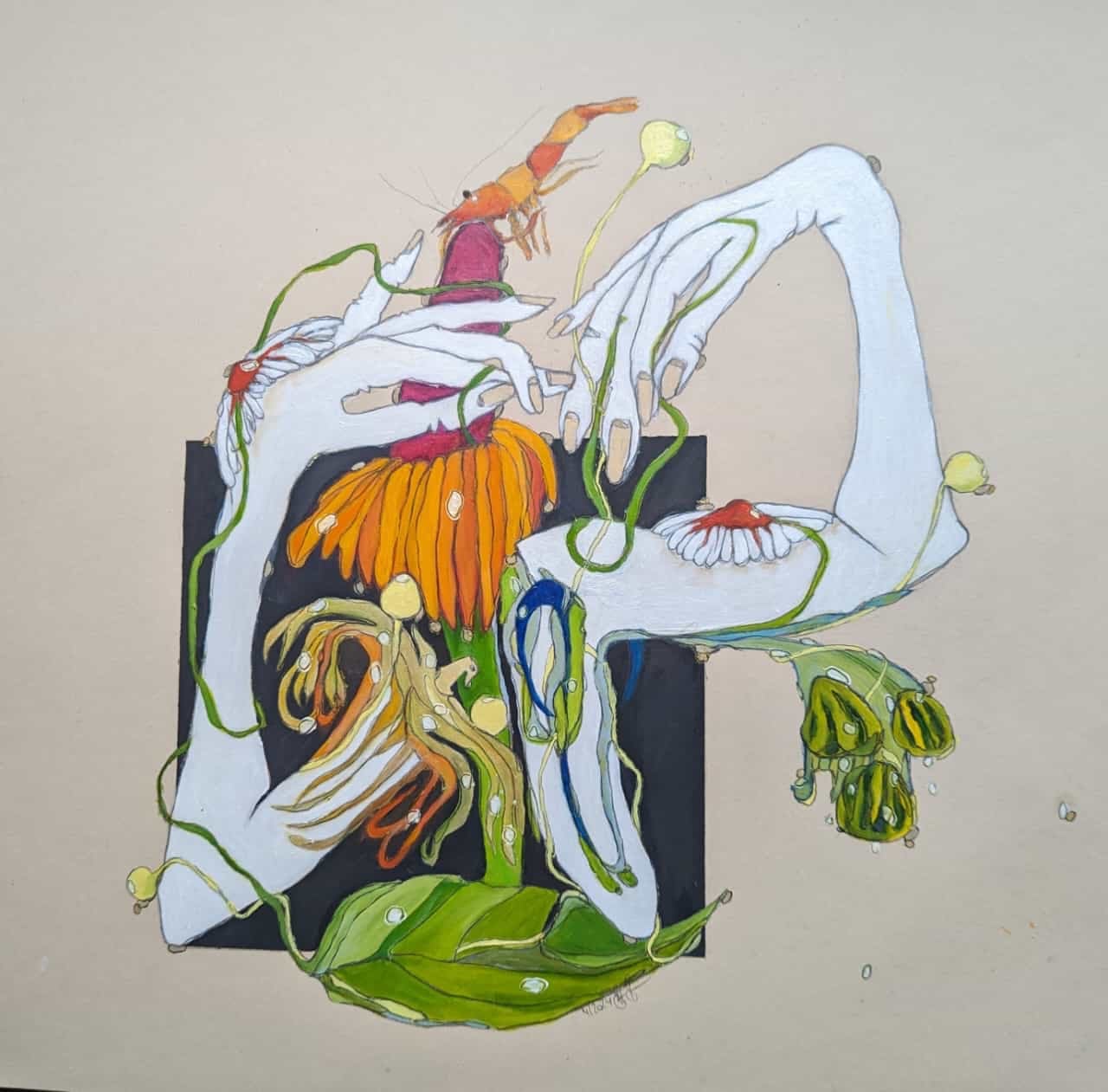
1 | About the Image "Back View", Oil on Paper, 50 x 50 cm
The image shows a drawing of two arms with hands swinging over the shoulders. The head and spinal cord appear as an Echinacea plant with a shrimp sitting on its bloom. The lower edge of the image is bordered by a leaf. The left arm ends at the shoulder with a bird, while the right shoulder blade has loops of plants.
What does this symbolism trigger in you? Simply take time to sense your own interpretation without evaluation or questions about why.
In contemplating symbols, it's never about right or wrong, but about the detective-like search for what might have meaning.
2 | The Psychological Functions and Their Artistic Representation
C.G. Jung describes four ego functions in his Analytical Psychology: Intuition, Sensation, Feeling, and Thinking. Imagine two axes: the vertical axis describes how we humans perceive the world—either more through intuition (perceiving the whole and its connections and the idea behind something) or through sensation.
Sensation is bound to the perception of reality: what I see, feel, hear, and taste, and what it points to. The horizontal axis of ego function describes how we as humans judge our perception. If I first say "this feels right or not right for me," I judge from the feeling function. If I recognize things in their object status and judge by categories of right or wrong, I prefer thinking as a judgment function.
Klaus-Uwe Adam has impressively described colors assigned to each function in his book "Ego Functions and Unconscious Painting."
In our example image here, which ego functions might it describe and how do they relate to each other?
The focus is clearly visible on the vertical axis—the theme is perception. Yellow is assigned to intuition, green to sensation. Thus, although the Echinacea bloom appears large and as a symbol of the head might tempt us to recognize intuition as the dominant perceptual function, green dominates, hence sensation. Could we say the image speaks of a person who can not only think their grand world of ideas but also deeply feel it?
And looking at the horizontal axis of judgment, which depicts feeling on the left and thinking on the right, we see the color of thinking (blue) on the right side. The color of feeling (red) appears as violet more in intuition (in the head), although here the bird developing from the arm becomes a symbol of free feeling.
In conclusion, one might venture the interpretation that this oil drawing describes a powerful perception of the world from the realm of ideas and simultaneously through the body. One could also say that body and mind are balanced here and form a strong alliance in contact with the world. One might suspect that the artist is very conscious of their perception of the world. It will be exciting to see whether another image might also thematize the relationship between feeling and thinking in relation to the world.
With the same interpretive approach of ego functions, I enthusiastically viewed the exhibition of Hilma af Klint compared to Wassily Kandinsky at K21 in Düsseldorf. There one finds a whole cycle of how humans differentiate and refine their perception.

Would You Like to Explore Your Own Symbol World?
Discover in psychological counseling how your inner images and symbols can guide you to deeper self-understanding.
Book Free Initial Consultation