Partnership with AI - Can Augmented Leadership Succeed Without Human Inferiority?
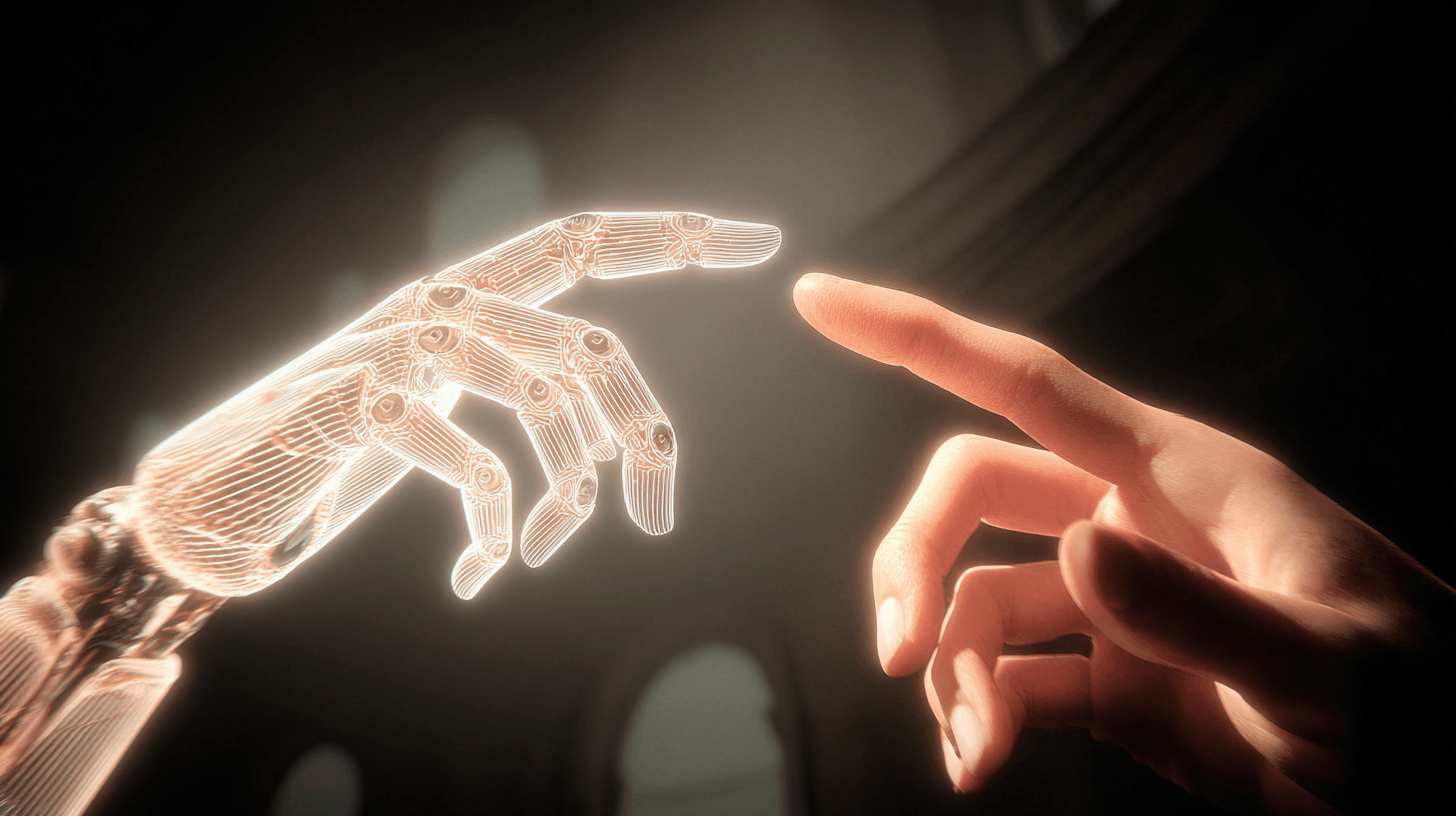
 Image was generated with AI
Partnership with the Machine - Can Augmented Leadership Succeed Without Human Inferiority?
Summary: Artificial intelligence challenges leaders – not technically, but emotionally. Augmented Leadership doesn't mean replacement, but partnership between human and AI. This article shows how to overcome loss of control, develop authority of meaning, and lead consciously rather than merely react.
1 | Between Fascination and Fear
Artificial intelligence is no longer a distant vision of the future – it's everyday reality. It writes texts, recognizes patterns, makes predictions, and supports decisions. For many leaders, this brings relief – but also a quiet unease. Because there's this question that we often ask ourselves, that's even discussed publicly: What actually remains of the human when the AI is more objective, faster, and seemingly smarter? The question of human value is a core question of our time and in leadership. Humans, inventors of AI, are suddenly compelled to justify their own nature.
Behind the widespread skepticism or uncertainty about AI often lies not a technical problem, but an emotional one: the fear of inferiority. When something non-human suddenly does things better that were previously our domain, it triggers deep-seated feelings of loss of control.
1.1 The Psychological Dynamic: When Control Begins to Falter
Leadership has always meant having control: over processes, decisions, results. But the introduction of AI touches precisely this point. It challenges what was previously taken for granted – and confronts us with something many avoid: sharing power.
When the feeling arises of being "subjected" to an AI, many instinctively react with resistance. Defense mechanisms are important psychological protective functions that can be precisely understood to learn emotional self-regulation. People doubt the results, avoid using it, or downplay the technology. These are protective mechanisms to secure one's own role. But they prevent development.
The first step toward mature leadership in the AI age is to allow these feelings: the irritation, the resistance, the fear. Those who don't suppress them can better understand them – and transform them into constructive energy.
 Image was generated with AI
And precisely at this point, it's decided whether we react or shape in future leadership. The interface with the AI is not reason against more reason, but feeling against vector empathy. Is the AI also taking away the human domain of empathy?
1.2 How an Empathetic Message from an AI Works
An empathetic message from AI is based on recognition and imitation. It analyzes language, tone, and patterns to generate appropriate responses. This can make it seem empathetic because it reproduces the external form of empathy (e.g., compassionate words, gentle tone, friendly phrases).
What it lacks is inner resonance: an AI doesn't "feel" along, it simulates compassion.
This means:
- In simple interactions (e.g., customer service, standard feedback), this often seems sufficient and can even be perceived as pleasantly neutral.
- In highly emotional situations (e.g., personal crises, conflicts, trust work), the effect remains weaker because people unconsciously notice that there's no real counterpart.
AI can simulate empathy – humans can feel empathy. AI can be a neutral advisor, but humans comfort. That's precisely what makes the difference in depth and bonding effect.
2 | Augmented Leadership: Enhanced Leadership Instead of Replacement
2.1 What Does Augmented Leadership Mean?
The term Augmented Leadership describes a new form of leadership in which humans and AI don't compete, but cooperate. "Augment" means to enhance, not replace.
AI can capture data volumes, recognize patterns, and prepare decisions – thus offering a rational supplement. Humans, on the other hand, bring emotion, values, meaning, and the ability to hold contexts long-term and enter into relationship with the world.
The goal is not to automate leadership, but to make it more human and conscious – through better information, clear reflection, and targeted relief.
AI is not a replacement for leadership – it's a mirror that shows how we lead.
2.2 Authority of Meaning as a Leadership Instrument
Imagine a leader – let's call her Clara. Clara leads an interdisciplinary team and uses an AI tool that creates mood analyses from anonymous feedback. The AI recognizes trends, such as that communication in the team seems "tense" and motivation is declining.
At this point, Clara could leave the interpretation to the AI and automatically derive measures – such as new meeting formats or training. But that would be like listening only to the words in a relationship, without sensing the emotional subtext.
Instead, Clara uses the data as an impulse – not as truth. She takes time to understand the result in context: Which projects were particularly stressful recently? Were there unclear expectations or unspoken conflicts? She goes into the team meeting with this attitude and says openly:
"The AI shows me that the mood has been more tense lately. I want to understand now what you're experiencing – not what the algorithm thinks."
Thus she transforms technical information into human dialogue. And at the same time, Clara makes transparent that the data comes from AI. The AI provides structure, Clara brings meaning. The appreciation of the technological contribution gives Clara authority of meaning. This is precisely how her new leadership competence emerges.
3 | Empathy and Values – Outdated or More Important Than Ever?
In a world that's becoming increasingly digital, empathy seems almost out of time. But exactly the opposite is true.
Empathy is what machines will never truly be able to do: sense resonance. While AI reacts, humans can enter into relationships. That remains the core competence of effective leadership: listening, perceiving, connecting.
Values also remain central. They are the compass that helps make decisions not only efficiently, but ethically and humanly meaningfully. AI can calculate probabilities – but cannot create meaning.
Data provide orientation. Values give direction. Humans are still the planners of strategy. Because there's no strategy without commitment. Action can only be maintained long-term through attachment to values and emotional motives. Human action needs a feeling.
Strategy and commitment are important leadership competencies for the entire organization and can be systematically integrated and trained as part of leadership responsibility.
4 | Is AI Fairer Than a Human Leader?
4.1 The Illusion of the Neutral AI
Many people perceive an AI's decisions as more objective. Because it seems neutral, emotionless, free of prejudice. But this is a deceptive perception: AI is only as fair as the data from which it learns.
Interesting is why we still perceive it as more just: AI systems have no intentions – we don't attribute emotions or power games to them. That makes them appear "more neutral."
But true fairness only emerges when someone takes responsibility – not just calculates.
Here lies the human task: to examine, question, moderate. Humans take on ethical control, selective and evaluative. Humans hold the context, shape the environment in which AI, like an important employee, receives a place of special expertise.
4.2 Holding Space
"Holding space" is a term frequently used in coaching, leadership, and pedagogy. It describes a leader's or moderator's ability to create an atmosphere in which people feel safe to express their thoughts and feelings without the leader immediately judging, controlling, or steering everything themselves. The space described here is a kind of atmosphere that can be learned through specific communicative skills in leadership training.
5 | Partnership Instead of Submission: What We Can Learn from Successful Relationships
A partnership with an AI sounds paradoxical – yet it resembles many dynamics we know from human relationships. When two systems work together, tension arises: Who decides? Who may make mistakes? How do we deal with difference?
From relationship research we know: stable relationships don't arise through equality, but through consciously shaped difference. They succeed when both sides
- respect their peculiarities,
- address conflicts openly,
- and build trust slowly but consistently.
Applied to leadership, this means: The AI may be rational – humans may remain emotional. The strength lies not in dominance, but in complementarity.
Thus partnership emerges: not romantic, but mature. The AI doesn't have to be loved for us to enter into relationship with it. But respected.
6 | Ready for a New Partnership?
6.1 Psychological Self-Leadership as Foundation
For this new balance to work, psychological self-leadership is needed. Leaders must learn to observe their own reactions rather than being controlled by them. They must not only become aware of their role as authority of meaning and context designer, but should develop strategic judgment and value consciousness and be able to relate them. As mediators between AI and human, a special communication ability must be developed: both externally and internally.
6.2 Developing Inner Communication Ability
When thoughts arise like "I'm being replaced" or "AI is taking my place," a brief moment of pause is worthwhile: Is that a fact – or a fear?
Those who can create this distance gain clarity. And clarity is the new form of strength.
Because leadership in the digital world doesn't mean knowing or controlling everything, but remaining conscious when everything changes. And the central new inner dialogue could be: Which information do I give meaning to? What is truly strategically relevant for my team? What direction do I give and how can I use AI as orientation?
7 | A New Balance: Leading Consciously Rather Than Controlling
7.1 From Control to Awareness
Augmented Leadership succeeds when people understand power not as possession, but as relationship competence. When they accept that not control, but awareness becomes the central leadership resource.
The AI remains a tool – but it can become a mirror: for our values, our patterns, our need for security.
Leadership thus becomes an inner practice: the ability to allow trust, share responsibility, and above all give direction.
The future doesn't belong to those who defeat AI systems, but to those who enter into relationship with them – without fear, but with attitude.
7.2 The Human as Conscious Center: Leading from Self in Context
Leading in a world shaped by AI requires understanding oneself no longer as the center of control, but as the center of perception. This means: I am not my role, not my fear, not my knowledge – I am the space in which all this takes place.
Those who understand themselves this way can integrate the AI into this space rather than feeling threatened by it. AI then becomes not an adversary, but part of the larger system that I help shape.
This becomes tangible when leaders pause before acting – when they observe how they react before deciding what to do. This small pause, this conscious "interposing," creates precisely that: space between stimulus and reaction. And in this space, leadership emerges – not from power, but from awareness.
The AI may calculate. But only humans can feel the context in which it gains meaning.
💬 Reflection Questions for Leaders
What spontaneously comes to mind when I think about "cooperating with AI"? Would you like to find out how you unconsciously react to the topic of AI in a quick check? Then I recommend the short test on my website: Quick Test: What Moves You Unconsciously?
- How do I deal with loss of control? What does it trigger in me when AI supports decisions or takes work off my hands?
- What do I want to embody in this new collaboration? Security? Openness? Responsibility? What attitude do I wish for myself?
- Where does my need for control end – and where does trust begin? How can I consciously practice shaping this transition?
- How do I talk to my team about AI? Do I promote fear or curiosity, distance or dialogue?
- What values should guide my leadership, even when algorithms co-decide? What remains non-negotiably human in my role?
- When do I consciously take time to pause before reacting? Where could precisely this moment make the difference – between reflex and genuine leadership?

Professional Support for Leaders in the AI Era
Are you facing the challenge of meaningfully integrating AI into your leadership role and want to learn how to strengthen your authority of meaning? I support you with individual coaching to develop Augmented Leadership – and consciously shape your leadership competence.
Book Free Initial Consultation